What is a Portrait?
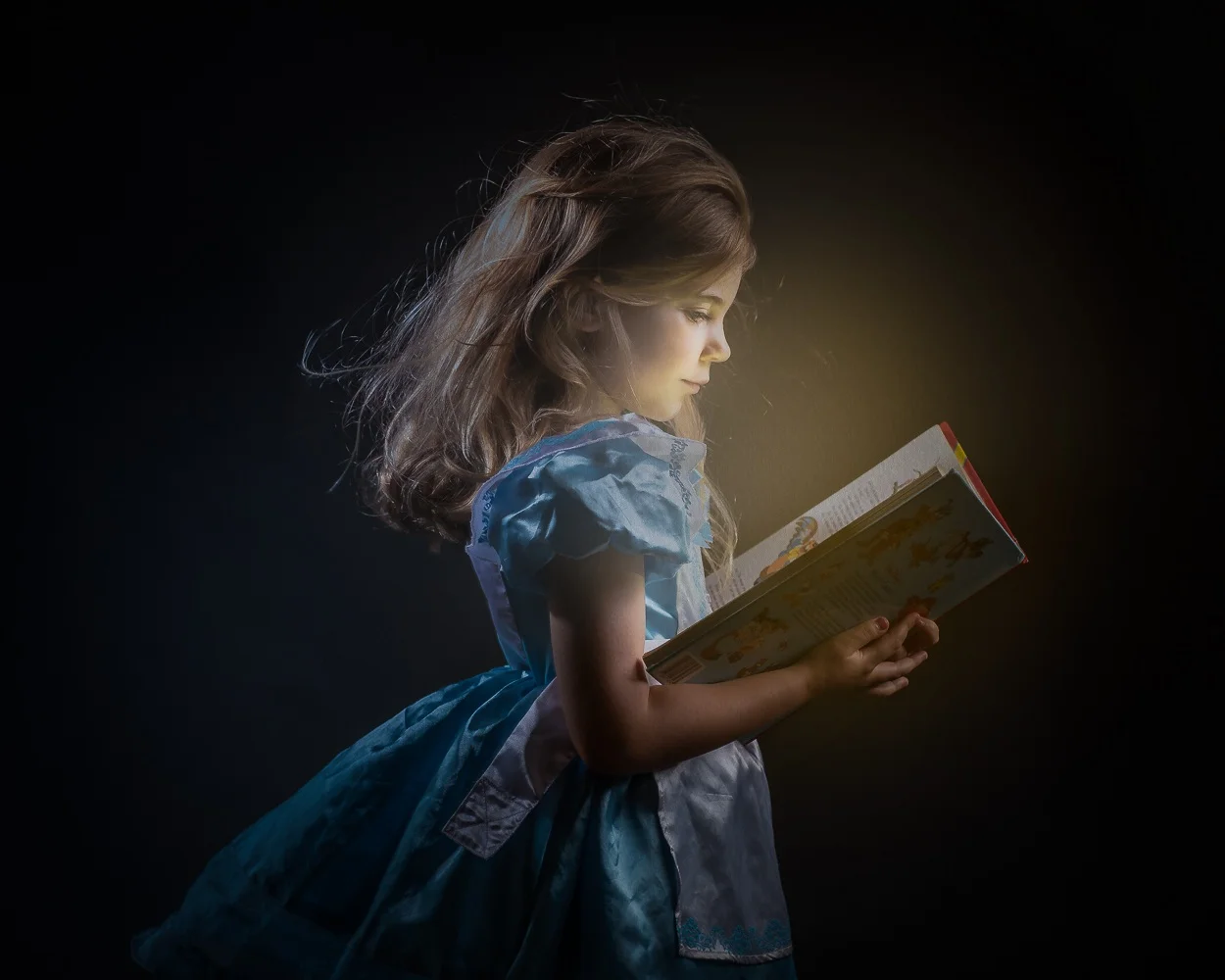
This is a portrait of my little girl, captured in April 2019. She is just at the age where she is learning to read and I wanted to capture the moment in her life when books were a way of entering a magical wonderland.
Summary
In this article Grain & Weave founder John explores the difference between ‘creating a portrait’ vs ‘taking photos’.
A true portrait is intentional in its communication and tells a story about the subject, often using objects or their environment, in a particular moment in time. Its purpose is ‘legacy’, or ‘historic interpretation’ whilst being presented or expressed through art.
A modern family portrait should combine elements of the above that reflect the family’s personality and traits; playful, cuddly, relaxed or the interplay between family members.
Maybe more traditional families might like classic, formal styles, or portraits that show status.
The intention as well as the execution is the difference between a ‘photo that you like’ vs a ‘portrait that you feel deeply connected with’.
Introduction
For decades we have been using cameras to document important moments in our lifetime; weddings, baby photography, birthdays and special occasions.
If the goal is to simply remember a time or a moment, such as the arrival of your newborn baby, then it’s easy to point and shoot so we get a visual reminder of who was there and what it looked like.
A portrait is something a seperate though. I often get asked by my families during their in home baby and family photography sessions the difference between a photo and a portrait. I usually reply with “if this camera was a brush and I was painting your portrait; what would we bother to paint in and what would we leave out?”
What, really, is a portrait?
Portraiture is a very old art form and dates back to at least Egyptian times, more than 5,000 years ago. Traditionally, a painting or a sculpture was the only way in which to record someone’s likeness (or how they wanted to be portrayed) and it was a very expensive endeavour.
The most successful portrait artists were the ones who could flatter their subjects and show them in a way that was pleasing or aspirational – powerful, wealthy and handsome.
Not surprisingly, it was only the powerful and wealthy (not always handsome) who could afford to commission such a venture.
“A portrait is a representation of a particular person... portraits have always been more than just a record. They have been used to show the power, importance, virtue, beauty, wealth, taste, learning or other qualities of the sitter...”
Portraits & photography
As time moved on, somewhere around the 1600s, portraits became more about the general human existence; regular folk and the happenings of day to day life.

The Milkmaid – c.1658, This seemingly innocuous image is a masterpiece of lighting and composition.
Artists began to see there were stories to be told in the little everyday moments.
During the 17th century, my personal favourite artist Johannes Vermeer painted masterpieces such as The Milkmaid, The Girl With the Wine Glass, The Girl With the Pearl Earring and more, which gave the viewer a glimpse into a scene of daily life.
These images are not just everyday snapshots, but each item that has been included is there for a reason and often doing multiple jobs; to tell the story, aiding in composition, add depth, colour or texture.
It is worth reminding that these images are painted and the representation of the soft, beautiful light and the interplay between the light and shadows is all done with brushstrokes; quite masterful.
With images such as these growing more popular, it was not surprising that a less formal and natural style began to filter its way down the line into personally commissioned portraiture by the wealthy and the elite of the era.
Photography
Some two centuries later, the camera and the photograph were invented. The technology was basic, with exposures taking up to a minute! Not ideal for capturing photos of babies or toddlers! Many of the earliest photographs were of landscapes and still-life.
To have a chance of capturing a remotely sharp image, people had to stay very, very still.
Before long, people realised the ease and accessibility to portraiture that cameras were bringing in, as opposed to the costly, time-consuming paint-portraits of old and there is something inherently basic about wanting to capture your time on this planet, leaving a memory that you were here and you existed, or even mattered.
The cost was still high and not everybody was able to commission a portrait, but that was coming and the portrait photography industry was born.

Victorian family portrait. They did well to keep that baby still!
During the late 1800s, portrait photographers were well known to have used posing stands – which looked a bit like hat or coat stands – and people stood against them or leaned on them to limit the movement of the subject. Blinking was discouraged.
This made the classic Victorian family portraits very stiff and posed – a trend that curiously seems to still exist today.
After all, have you ever wondered why we still pose and look at the camera, holding a smile and staying still?
Old vs new
By the mid 20th century, photography was still developing (pun intended) as an art form and the accessibility of a camera or studio to the wider public began to turbo-charge the rise of the photographic era.
Now it wasn’t only the well-to-do who could have their portrait created, but the middle classes too.
The process for capturing a photograph and developing the film was still fairly time consuming and costly in those days, so the approach to image creation remained very much the same; posing a subject and keeping them still. An intentional representation and not just a quick snapshot.
A photo took some setting up and required thought and planning, much like the portraits of old.
Modern portraits - a massive leap
During the late 20th century wedding photography was captured using film and the photographer still needed to understand quality of light, metering, ratios, lighting styles, composition and posing.
A photographer was expensive because they were highly skilled and the equipment was costly. Look through your grandparents wedding albums and you’ll see lots of set-ups and poses; or bad photographs because they ‘were doing it on the cheap!’

Old family wedding photos. I’m pretty sure this was a DIY job!
Fast forward to today, we all have access to amazing cameras 24/7, which need little to no thought to use.
If I am attending a once-in-a-lifetime event, enjoying a night out with some friends or simply just having a great meal, I can whip out the phone from my pocket and use the camera app to capture it to remember.
There is zero processing cost or effort (much to the detriment of the rest of the world, who doesn’t want to see my spaghetti bolognese).
I can even take a ‘selfie’ with my dog.
The client has now become the photographer, very much like the DIY enthusiast has become the tradesperson. You still would hire a professional to do the important jobs though.
It is worth saying at this point, now we have the ability to use camera phones everywhere we go; we must always be present enough to actually enjoy the moment that we are experiencing. I went to see Paul McCartney in concert here in Sydney a some years back; something I’d wanted to do for most of my life; and I made a point of keeping my phone in my pocket most of the time (I did take a few videos!) but I would say at least two-thirds of the audience were almost constantly watching the concert through their phone, when he’s actually there! I enjoyed the concert so much more and the memories I have are far better than the footage. The footage does evoke the memory, which is what it’s really for.
Casual, natural portraits are older than you think…
As a photographer, I love to capture classic portraits, but for families I feel it is preferable to capture them when they are at their most relaxed and it is how people like to see themselves most of the time.

Zenaide and Charlotte Bonaparte, 19th Century – by Jaques Louis.
You’d be forgiven if this was a new or modern idea though – during the 18th century, the informal, natural and casual style of portrait was very popular.
It featured groups of people interacting as if the viewer were there, looking through a window or even part of the moment. It was a very different direction to the classical and posed style that preceded it.
Some say that the rise of the digital camera, giving the ability to easily capture a photograph in the hands of the general public, has ruined the industry; but I disagree.
Like Vermeer, everybody now has the opportunity to capture everyday moments and like the Victorians, they can document their family without requiring a disturbing posing stand or suffer from dry eyeballs from not blinking.
People can now celebrate family and togetherness. Just like my footage from my concert, great photos evoke memories.
It is well known that families who display photos of themselves around their home have a deeper sense of this togetherness and their children grow up feeling loved and empowered with what it means to be a cohesive family.
Creating layers to tell stories
I know that when I’m looking at photos of my family, the images I enjoy the most are the ones that remind me of a specific feeling as well as a time.

‘Inseparable’ - ©Grain&Weave - portrait by John.
When I was a little boy, I worked out that I could easily get around my mum with a cheeky smile – it worked every time – and unsurprisingly, any photo that had that particular expression was always the one that my mum loved the most, as it defined my whole childhood.
If I was to create a portrait of my late grandfather, which sadly is not possible, I would certainly have him surrounded by the hundreds of tatty old music books he had; maybe including his old 1970s hammond organ that he used to play every single day.
Of course, it would be a picture of him, but atop the organ would be a book, opened to the page with his favourite song that he always started with. He would be wearing the old slippers my nan bought him 15 years before and he would certainly not be smiling, as he was a very serious, but loving, man.
So I ask you, if you were creating a portrait of someone you know, what would you bother to paint in and what would you leave out?